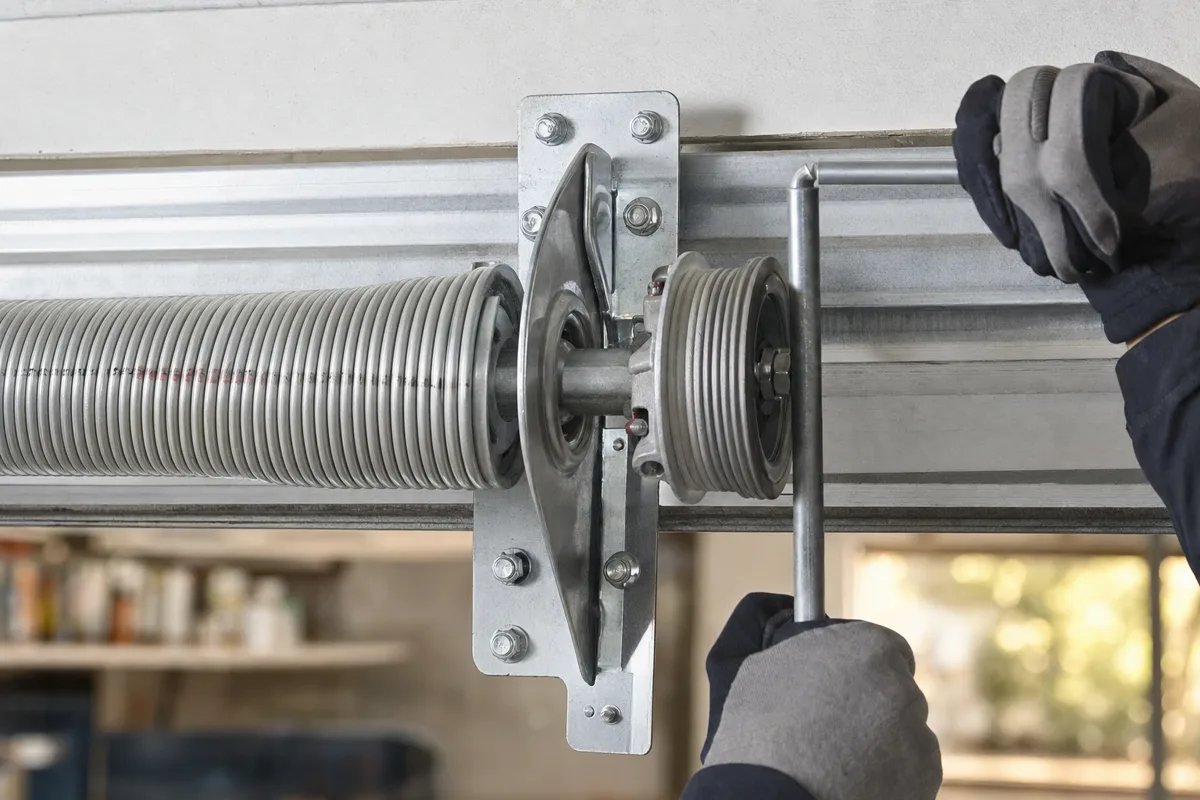

Garage Door Spring Replacement
Torsion and extension spring replacement done with proper tensioning tools.
View serviceA broken spring removes the counterbalance that makes a heavy garage door manageable. Recognize the signs from a safe distance, keep the door closed if possible, and do not try to wind or replace a spring yourself.
A broken garage door spring usually leaves the door extremely heavy, unable to lift normally, or stuck with the opener straining. You may see a clear gap in a torsion spring above the door or hear a loud bang when it breaks. Stop using the opener and do not touch the spring, cables, or winding hardware because they remain under serious stored force.
Garage door springs do far more than lift the door. They store energy to counter most of its weight, so the opener and a person can move it in a controlled way. When a spring breaks, the opener may hum, the door may lift only a few inches, or the door may suddenly feel much heavier than usual. You may also hear a sharp bang from inside the garage. A spring can break after fatigue; many are commonly rated at roughly 10,000 cycles, though the actual life varies with door weight, use, weather, and installation. The key is not to test a suspected failure by forcing the door.
Start at the top. The early checks are the most common causes and need no tools.
Stand back with the door closed and look above the opening for a torsion spring with a visible separation in its coil. Some doors use extension springs beside the horizontal tracks instead. Compare both sides only visually; do not touch, pull, or hook anything around a spring.
What it means: A clean gap in a torsion coil is direct evidence that the spring has broken.
Think back to the moment the failure started. A spring can make a loud crack or bang when it releases, often mistaken for something striking the garage. The door may still be closed and look ordinary afterward, so do not assume the sound was harmless if the opener then struggles.
What it means: A bang followed by a heavy or stalled door strongly supports a broken-spring diagnosis.
Press the opener once while keeping the door in sight. If it hums, lifts the door only a little, or reverses because the door is too heavy, release the control. Do not repeat the test. The opener is not designed to lift the full weight of an unbalanced door.
What it means: An opener that cannot raise a previously normal door may be facing missing spring counterbalance.
Observe both bottom corners during a single attempted opening. One side rising while the other stays low, or a cable that looks loose, may mean the lift system has lost balance. Do not pull the emergency release when the door is partly open or supported only by the opener.
What it means: Uneven travel or a slack cable means the door should remain out of service until examined.
Only if the door is fully closed, the opener is not running, and no cable looks loose, you can avoid further tests rather than lifting it. A suspected broken spring does not require a manual weight check. The visible symptoms above are enough to arrange repair without adding risk.
What it means: Choosing not to force a heavy door is the correct conclusion when a spring failure is likely.
Spring work is high risk. Springs, winding cones, cables, and bottom brackets can transfer enough energy to cause severe injury. Do not loosen set screws, insert tools into winding hardware, cut a spring, or detach a cable. Do not use the opener to compensate for a suspected broken spring. Keep the door closed, keep people clear, and submit the online booking form for spring repair or replacement.
Large seasonal temperature swings in unheated attached garages can make a spring failure show up after a cold spell or during the busy morning of the season. The temperature change does not prove the cause, but it can expose an older spring already near the end of its service life. Many central Mississauga homes built from the 1950s through the 1970s may still have older doors or first-replacement hardware. A door that has become noisy, jerky, or heavy deserves attention before a complete spring break.
Fill out the form and we'll confirm your appointment by email.
These guides are written for Mississauga homes. If the fix is beyond a homeowner check, we work everywhere inside this area.
Map data © Google. Pin shows the service area, not a walk-in location — all work is done at your home.

A real callout, not stock imagery.
A sectional door pulled off its tracks, taken down and supported on site so it could be checked and re-hung safely — photographed on the job.